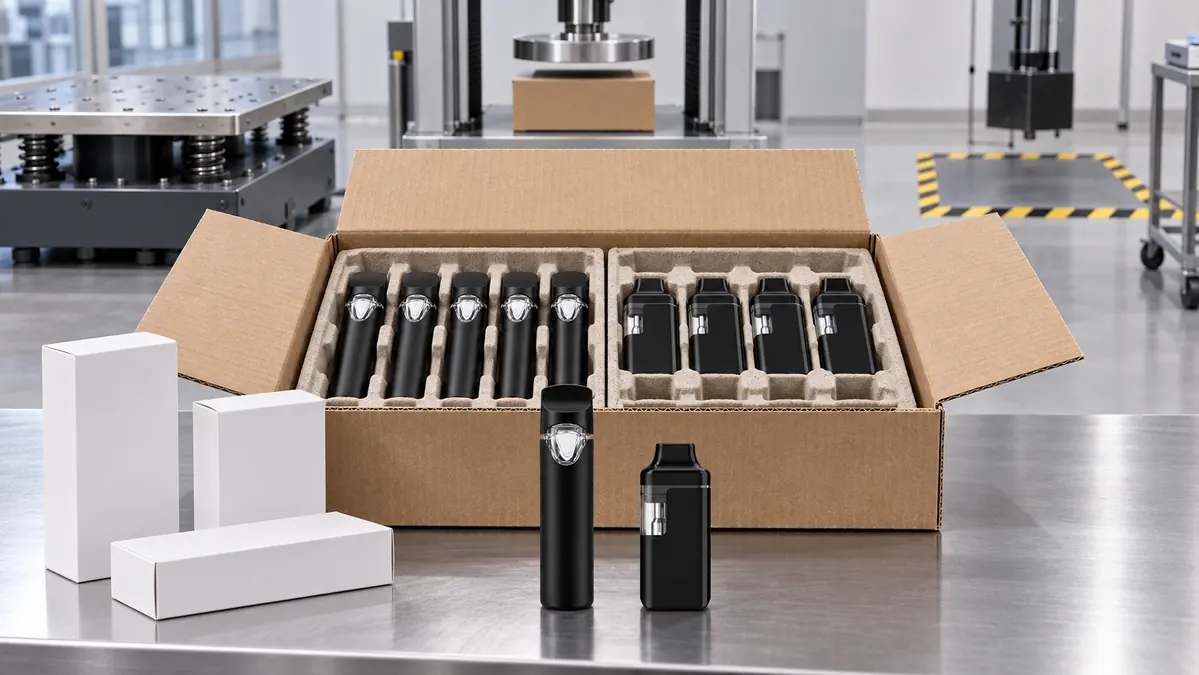
A strong master carton is not proven by board grade, burst strength, or a clean sample alone. Wholesale buyers need evidence that the complete packed system—device, retail box, inner tray or divider, master carton, closure method, pallet pattern, and handling route—can reach the receiving dock without creating avoidable damage, leakage, cosmetic rejects, or mixed-condition inventory.
That is the purpose of disposable vape shipping carton validation. For buyers planning bulk disposable vapes, validation means defining the distribution hazards that matter, challenging a production-representative pack-out, inspecting the product after the challenge, and recording acceptance criteria before the bulk order moves — not chasing an indestructible carton.
This validation step sits between case-pack planning and the pre-shipment release checklist, and it builds on the custom packaging specifications already set for the retail box and carton. It also gives the receiving team a reference condition when the shipment arrives.
Start With the Distribution Route, Not a Random Drop Height
A carton shipped as an individual parcel does not experience the same handling as a stretch-wrapped pallet moved by forklift. Air freight, ocean freight, parcel networks, cross-docking, warehouse stacking, and last-mile delivery create different combinations of impact, vibration, compression, temperature, humidity, pressure, and repeated handling.
Before selecting a test, document the intended route and the actual shipping unit. At minimum, record:
- packed carton dimensions and gross weight
- units per inner pack and units per master carton
- retail-box orientation, dividers, trays, cushioning, and empty space
- carton board specification, closure tape or adhesive, and straps if used
- parcel, pallet, LTL, air, ocean, or mixed-mode handling
- expected stacking pattern and warehouse dwell time
- product condition at test start, including filled or unfilled status when relevant
The protocol should follow the route and risk profile. For example, ISTA 3A is a general simulation procedure for individual packaged products moving through a parcel-delivery system at 70 kg (150 lb) or less. It should not be applied automatically to a palletized freight program simply because both shipments use corrugated cartons. ASTM methods can separately address loaded-container free-fall drops, shipping-container vibration, and compressive resistance, but each is a method family the buyer still has to apply against the specific route and risk profile.
Build a Production-Representative Test Pack
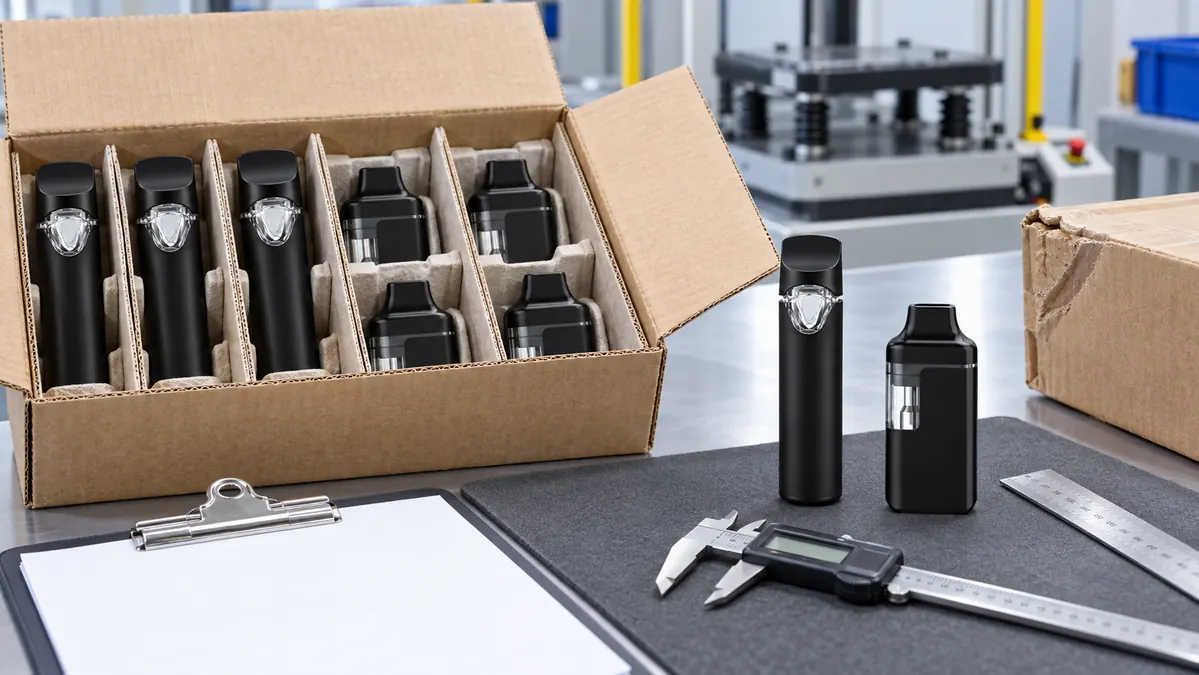
Testing an empty carton or a hand-packed display sample can hide the failures that appear in production. Use normal production components, normal retail boxes, the approved inner-pack pattern, the intended master carton, and the real closure method. Pack to the approved count and target gross weight.
The sample should also preserve traceability. Record the product model, packaging revision, carton supplier or lot, pack-out date, operator, sample quantity, and any deviations. If packaging changes later—board grade, divider geometry, retail-box size, unit count, tape pattern, pallet pattern, or product mass—the buyer should decide whether the previous result still applies or whether revalidation is needed.
Use a Test Sequence That Matches the Failure Modes
1. Visual and dimensional baseline
Photograph all carton faces, seals, corners, labels, and inner-pack geometry before testing. Record carton dimensions, gross weight, closure pattern, and product orientation. This baseline prevents normal pre-existing marks from being misclassified as transit damage.
2. Impact or drop challenge
An impact challenge evaluates what happens when a loaded carton meets a face, edge, or corner during handling. ASTM D5276 covers free-fall drop testing of loaded containers, while ISTA procedures define distribution-specific sequences. Select the method, orientations, number of impacts, and height from the applicable protocol, packed weight, shipping mode, customer requirement, and laboratory advice—not from a generic online chart copied into a purchase order.
After the challenge, inspect more than the outer carton. A carton can look acceptable while retail boxes shift, devices rub, mouthpieces loosen, windows crack, or units develop hidden functional problems.
3. Vibration challenge
Road, conveyor, aircraft, and mixed-mode handling can repeatedly move the product inside the package. ASTM D999 provides methods for vibration testing of shipping containers. The buyer should specify the chosen method and duration, then examine divider movement, abrasion, scuffing, label damage, cap or mouthpiece retention, leakage, and product-to-product contact.
4. Compression or stacking challenge
The bottom carton in storage or pallet transport carries load from above. ASTM D642 addresses compressive resistance of shipping containers, components, and unit loads. A useful plan defines the load basis, duration, support condition, pallet pattern, and acceptable deformation. Do not treat a carton supplier’s generic box-strength value as proof that the final packed configuration will survive the intended stack.
5. Conditioning when the route makes it relevant
Paper-based packaging changes with humidity, while some routes expose the pack to temperature or pressure variation. If these hazards are material, define conditioning and recovery rules before mechanical testing. The purpose is to reproduce a credible distribution condition, not to add dramatic laboratory steps that have no relationship to the route.
Define Pass/Fail Criteria Before Testing
A test without written acceptance criteria becomes a debate after damage appears. The purchase specification or approved validation plan should separate packaging integrity, product condition, and function.
Packaging checks may include:
- no content release, burst seam, or closure opening
- no carton collapse beyond the agreed dimensional or stacking limit
- retail boxes remain contained, identifiable, and saleable
- dividers or trays remain in their intended positions
- labels, lot codes, and barcodes remain readable
Product checks may include:
- no cracked tank or window, distorted enclosure, loose component, or visible seal displacement
- no abnormal leakage or contamination attributable to the challenge
- no unacceptable dent, scratch, print damage, or color transfer under the agreed cosmetic standard
- no unit migration that creates product-to-product impact
Functional checks should use a defined sample and method. Depending on the product and program, buyers may check activation, airflow, output consistency, charging-interface condition, indicator behavior, or other approved functions. The protocol should state what is tested, how many units are checked, and what constitutes a failure. Avoid implying that a carton test alone proves battery safety, dangerous-goods compliance, shelf life, or regulatory conformity.
Turn the Result Into a Controlled Approval Record
The final report should identify the test method and revision, laboratory or test location, equipment, pack configuration, environmental conditioning, test sequence, sample IDs, observations, failures, photographs, and disposition. Record whether the result is approved, conditionally approved with corrective action, or rejected.
If the pack fails, change one meaningful variable at a time where practical—such as divider support, void control, carton grade, closure pattern, pack count, or pallet pattern—and retest the revised configuration. Keep the failed evidence. It explains why the approved packaging revision exists and prevents the factory from quietly reverting to an earlier pack-out.
Connect Validation to the Purchase Order and Shipment Release
The approved packaging configuration should become part of the commercial and quality record. Reference the carton drawing or specification, units per carton, inner-pack layout, closure method, labeling, palletization where applicable, approved validation report, and change-control requirement.
Before factory release, verify that production cartons match the approved configuration. At receiving, use a receiving checklist to compare physical condition with the validation baseline, photograph exceptions, segregate suspect cartons, and apply the agreed claim and disposition process. This closes the loop that starts at compare wholesale quotes and runs through packaging approval, release, and receiving.
Buyer Checklist
Before approving bulk delivery, confirm that you have:
- a documented distribution route and shipping unit
- a production-representative test pack
- a named test method and current protocol revision
- pre-agreed packaging, cosmetic, leakage, and functional acceptance criteria
- traceable samples and before/after photographs
- a controlled report with approval and corrective-action status
- purchase-order references to the approved pack-out
- a change-control trigger for packaging or product revisions
- a receiving plan for visible damage, concealed damage, segregation, and claims
Final Takeaway
Disposable vape shipping carton validation is a system check, not a box-only test. A defensible plan links the route, packed configuration, mechanical challenges, product inspections, acceptance criteria, and controlled records. Buyers who define those elements before shipment are better positioned to prevent avoidable damage, resolve packaging changes with evidence, and receive bulk inventory against a known standard.
For product selection and bulk program planning, review ILEVA’s bulk disposable vapes collection.