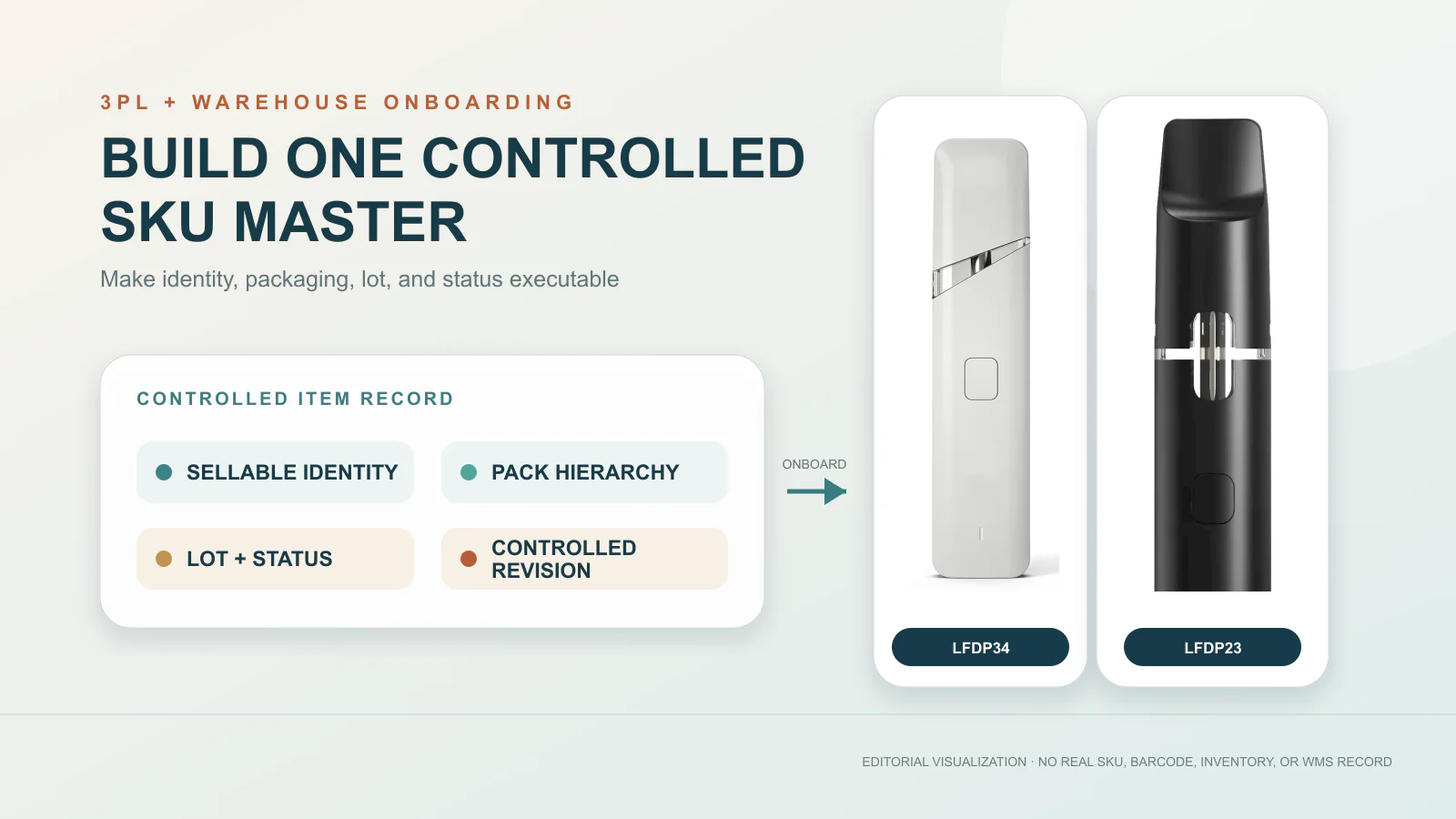
A warehouse can receive the right cartons and still create the wrong inventory.
Consider two disposable vape variants with the same device body and similar packaging. The spreadsheet calls both of them “Brand X 20K,” one carton label abbreviates the flavor, and the 3PL has been given only a case quantity—not the number of units inside. Nothing is visibly damaged. Yet the first receipt can still produce duplicate SKUs, an incorrect available quantity, or a pick that cannot be traced back to the right lot.
That is not mainly a storage problem. It is a product-master problem.
Before a bulk disposable vape assortment enters a 3PL or warehouse management system, the brand or distributor needs to define exactly what one sellable item is, how its packaging levels relate, which identifiers appear on the physical goods, and which controls must survive every inventory transaction. This guide provides a practical way to build and test that record without assuming that every company uses the same WMS, barcode standard, or status vocabulary.
Start with the unit the business actually sells
The first decision is the SKU boundary: which product differences create a separate sellable item?
For a stocked disposable assortment, flavor, nicotine strength where applicable, color, device format, and other approved commercial variants may distinguish one SKU from another. A difference should not be hidden in free-text notes if it changes what the customer orders, what the warehouse picks, or what the business must trace.
One SKU should point to one controlled sellable configuration. That does not mean every identifier is the SKU. Keep these roles separate:
| Identifier | What it answers |
|---|---|
| Commercial product name | What does the sales team and customer call it? |
| Internal SKU | Which sellable configuration does our system control? |
| Supplier model or reference | Which source configuration did the supplier provide? |
| Barcode or GTIN, where used | Which trade-item identity can a scanner or trading partner read? |
| Lot or batch | Which production population does this physical stock belong to? |
| Logistics-unit identifier, where used | Which case, pallet, or parcel is moving through the supply chain? |
A lot number should not be built into the permanent SKU simply because both appear on a carton. The SKU identifies the configured item; the lot identifies a production population of that item. Combining them can create a new pseudo-item for every receipt. Ignoring the lot does the opposite: it erases the boundary needed for investigation, hold, and controlled release.
Likewise, a marketing descriptor such as a nominal puff count can help identify an approved product configuration, but it should not be treated as a warehouse test result or performance guarantee. The item master should reproduce controlled product data, not turn promotional language into a new technical claim.
Build a record that another operator can use without interpretation
A good item master is not the spreadsheet with the most columns. It is the smallest controlled record that allows sales, purchasing, the 3PL, and inventory control to refer to the same physical item without guessing.
The exact fields depend on the system and program, but a practical onboarding record normally covers the following groups:
| Field group | Minimum questions to answer |
|---|---|
| Ownership and control | Who owns the record, which revision is current, and when does it take effect? |
| Sellable identity | What is the internal SKU, exact description, brand, variant, and supplier reference? |
| Scan identity | Which barcode, GTIN, or approved internal code belongs to each relevant packaging level? |
| Pack hierarchy | How many eaches are in an inner and a case, and which unit is ordered, received, stored, and shipped? |
| Physical attributes | What dimensions and weight are required by the 3PL for each relevant unit of measure? |
| Traceability | Must a lot, batch, serial, or other controlled production identifier be captured? |
| Inventory control | Which statuses can the SKU occupy, which are sellable or blocked, and may an approved substitute SKU be offered when this item is unavailable? |
| Handling | Which approved storage, routing, or handling flags must be passed to the operator? |
| Change control | What requires a new SKU, a revised record, or a written exception? |
Avoid blank fields whose meaning is unclear. “Not applicable,” “not supplied,” and “not yet approved” are three different conditions. A blank value can cause the warehouse to infer a default when the business actually has an unresolved decision.
The same discipline should be applied before onboarding a stocked assortment. The physical and commercial identity in the master should match the inventory evidence already verified with the supplier. A structured process for verifying disposable vape inventory before payment reduces the risk of building clean warehouse data around stock that was never adequately identified.
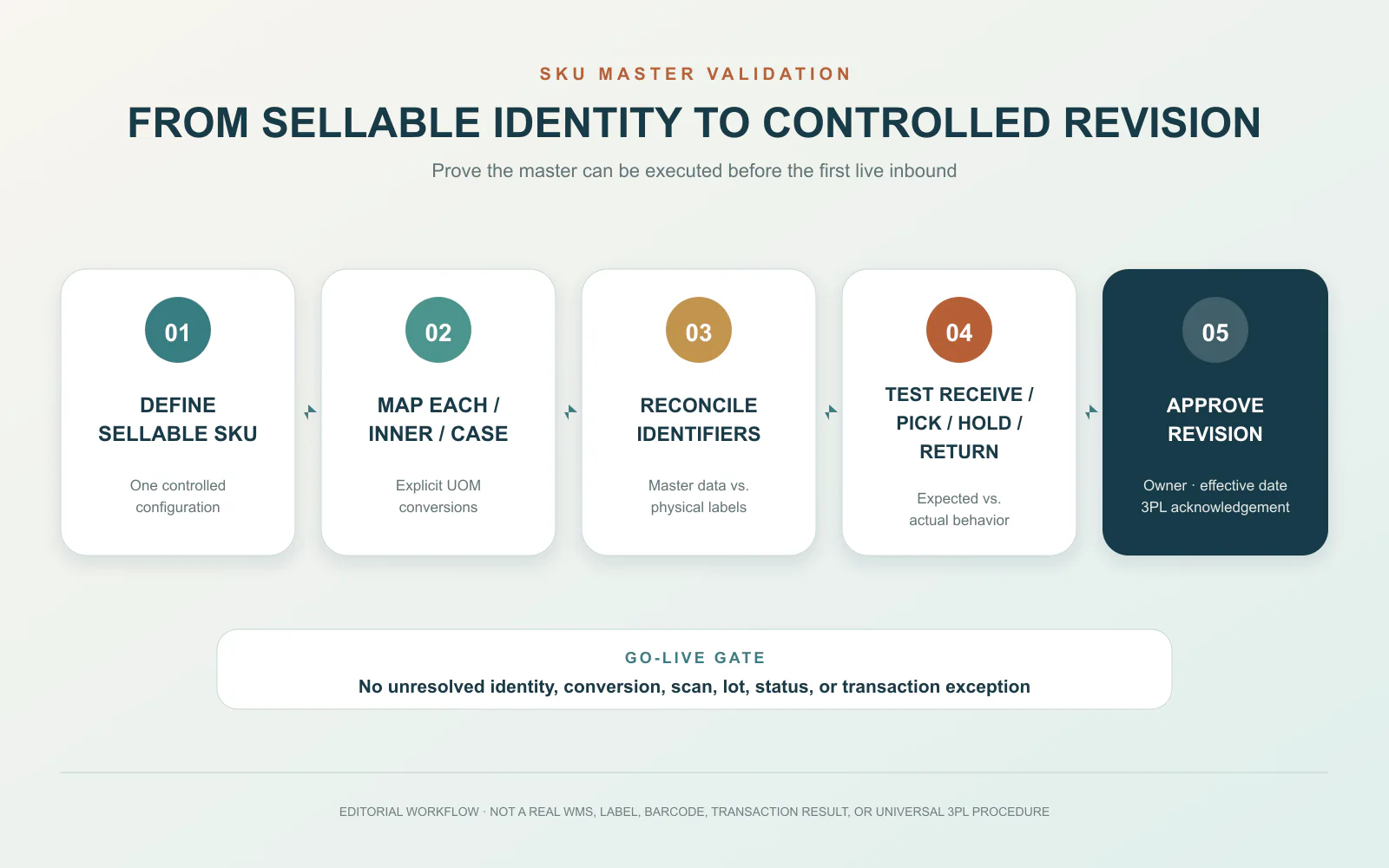
Treat each, inner, case, and pallet as a conversion—not a nickname
“One case” is not a quantity until the system knows what the case contains.
Suppose a SKU is sold by the each, packed 10 units to an inner, and 20 inners to a case. The item master should explicitly state that the case contains 200 eaches. If the receiving file says 40 cases while the WMS interprets the quantity as 40 eaches, the physical receipt can be correct and the available balance can still be wrong by a factor of 200.
For each relevant packaging level, record:
- the unit-of-measure code and plain-language name;
- the number of lower-level units it contains;
- the barcode or identifier used at that level, if any;
- dimensions and weight required for storage, freight, or system validation;
- whether the level is orderable, receivable, pickable, or shippable;
- whether mixed variants or mixed lots are allowed inside it.
GS1 distinguishes trade items from logistics units. A GTIN can identify a trade item at a packaging level, while an SSCC identifies a specific physical logistics unit assembled for storage or transport; it is not a static SKU-level barcode. These standards can support interoperability, but they should be adopted according to the company’s trading-partner and system requirements—not copied into a template as if every business must use the same identifiers.
This reconciliation principle applies regardless of which WMS or barcode standard a company uses: the digital hierarchy must match the physical pack. Ask the 3PL to scan or enter a sample each, inner, and case before go-live. If the system finds the wrong SKU, uses the wrong conversion, or accepts the same code for two different identities, stop and resolve the mapping before an inbound appointment is booked.
Preserve lot identity and inventory status as separate controls
An item can be correctly identified and still be unavailable for sale.
The item master should tell the WMS whether lot or batch capture is required and at which transactions it must occur. The inventory-control design should separately define statuses such as available, inspection hold, damaged, discrepancy hold, return pending, or any other company-approved state.
Do not overload location names to represent status. A bin called “HOLD” can provide a physical cue, but it does not necessarily prevent a system allocation or pick. The intended restriction should be enforced in the system and tested.
Lot control also needs an aggregation rule. If one pallet contains several finished-goods lots, the receipt should preserve those lot identities rather than convert the pallet into one anonymous quantity. GS1 guidance emphasizes recording the relationships between trade items and their higher aggregation levels so the physical and electronic chains remain connected.
This is finished-goods control, not full component genealogy. A warehouse SKU master can preserve the lot code printed on a finished disposable product or case; it does not by itself prove which component lots entered production. That broader question belongs to the vape hardware component traceability system.
Reconcile the master against real labels before sending an ASN
Do not approve onboarding from a spreadsheet alone. Use representative photos or physical samples of the approved each, inner, and case labels and compare them field by field with the proposed record.
Check whether:
- the exact variant text can be read consistently;
- the code on each packaging level maps to only one SKU;
- the supplier model and your internal SKU have not been swapped;
- the printed case quantity agrees with the UOM conversion;
- the lot or batch format can be captured by the WMS;
- leading zeros, spaces, hyphens, or letter case are preserved where they affect matching, including after spreadsheet or CSV import rather than being truncated or reformatted;
- old and new label revisions could coexist during a transition;
- a mixed-SKU or mixed-lot carton would be visible rather than silently received as homogeneous stock.
If a label and the master disagree, decide which controlled source is correct before receipt. Do not ask the receiving team to choose the most plausible value at the dock.
For buyers selecting a stocked assortment from ILEVA’s bulk disposable vape options, this reconciliation is the bridge between commercial selection and executable warehouse data. The link does not make every listed product interchangeable; each approved sellable configuration still needs its own controlled identity and pack mapping.
Prove the setup with four transactions
The strongest review is a small dry run in the actual warehouse system. Use test data or a controlled non-sellable quantity and walk one SKU through four transactions.
1. Receive
Receive one case against a test inbound record. Confirm that the operator can identify the SKU, scan the intended packaging level, enter the required lot, and produce the expected each quantity. Then introduce one deliberate mismatch—such as the wrong lot format or case code—and confirm that the process stops or routes the exception visibly.
2. Pick
Create an order for a quantity that tests the defined pick unit. Confirm that the system allocates only available inventory, preserves the requested variant, and deducts the correct number of eaches. If the business allows case and each picks, test both.
3. Hold
Place part of the received lot on a controlled hold. Confirm that the held quantity remains visible for investigation but cannot be allocated to an ordinary order. Release only the test quantity and verify that the status history is retained.
4. Return
Process a test return. Confirm that the operator cannot silently add the unit back to saleable stock without the required identity, condition, and disposition steps. The return should resolve to a defined status, not to a free-text note that leaves the stock available by default.
Record the expected and actual result for each test. A successful upload is not the same as a successful operating process.
Once live inventory arrives, the prepared item master should feed a distinct receiving decision. The bulk disposable vape receiving checklist covers how to verify, segregate, and release the physical shipment without confusing “received” with “available.”
Control changes after go-live
Product-master errors often reappear after a clean launch because too many people can make undocumented edits.
Assign one record owner and define who may request, approve, enter, and verify changes. Then specify which events require action. Examples can include:
- a new sellable variant;
- a changed case pack or packaging barcode;
- a label revision that changes a controlled identifier;
- a new supplier reference for the same commercial item;
- a change in lot-capture or handling requirements;
- a discontinued item that must remain visible for returns and history.
Not every change requires a new SKU, but no material identity change should be hidden by overwriting the old record without an effective date and approval trail. Before activating a revision, repeat the transactions affected by that change.
Pre-onboarding release check
Before the first live inbound appointment, confirm that:
- every sellable configuration has one unambiguous internal SKU;
- product, supplier, scan, lot, and logistics-unit identifiers have distinct roles;
- each packaging level and UOM conversion matches the physical pack;
- every relevant barcode or internal code maps to only one intended item and level;
- lot-capture and inventory-status rules are explicit;
- held inventory cannot be allocated by the normal order flow;
- representative each, inner, and case labels reconcile with the master;
- receive, pick, hold, and return tests produced the expected results;
- exceptions have named owners and are closed before live inventory arrives;
- the active revision, effective date, approver, and 3PL acknowledgement are recorded.
The goal is not a perfect spreadsheet. It is a common operating language. When the commercial assortment, physical labels, WMS fields, pack conversions, lot records, and inventory statuses all describe the same product, a warehouse can execute without reconstructing product identity from memory. That is what turns approved stock into controlled, usable inventory.