
Two empty AIO devices can both be described as “2 mL” and still create different outcomes at pilot filling. One may fit the planned fill mass and carton but leave little room for the required process variation. Another may provide a larger reservoir envelope but may need a different insert, battery strategy, filling setup, or qualification plan. If purchasing compares only the capacity label, those differences remain hidden until samples reach the line.
For an oil brand or hardware buyer, capacity is therefore not a simple ranking. The right choice is the smallest configuration that can hold the defined product quantity and pass the complete filled-device, production, packaging, and commercial requirements of the program. That decision starts by separating the quantities that a label such as 1 mL, 2 mL, or 2 g can blur together.
Define the quantity before comparing devices
An RFQ that asks only for a “2 mL disposable” leaves several decisions unresolved. The buyer and supplier need to identify what the number describes, how it will be verified, and which tolerance controls the finished unit.
| Field | What it should mean in the project record | Why it matters |
|---|---|---|
| Nominal reservoir capacity | The supplier’s stated capacity class for the hardware | Useful for initial screening, but not proof of the approved fill quantity |
| Target fill volume | The volume the process is intended to dispense under defined conditions | Connects the formulation and filling method to the hardware |
| Target fill mass | The mass the finished unit is intended to contain | Often easier to control gravimetrically, but cannot be converted from volume without the actual formulation density |
| Fill tolerance | The approved variation around the target | Determines how the process and inspection plan distinguish acceptable units from exceptions |
| Headspace decision | The intentional unfilled portion, if required by the validated configuration | Must be based on the actual hardware, formulation, closure, and process rather than a borrowed percentage |
| Residual or unavailable volume | Product that may remain in the system under the defined use and test method | Must not be assumed from the reservoir label |
A gram is a mass unit and a millilitre is a volume unit. They are related through density, but the conversion is formulation-specific: target fill volume (mL) equals target fill mass (g) divided by the measured formulation density (g/mL). A 2 g claim therefore requires formulation-specific data; a sample sold in a 2 mL hardware class does not establish that claim. The project record should state the actual formulation, measurement method, target, tolerance, and approval evidence.
This distinction also prevents puff-count estimates from controlling the selection. A nominal liquid volume does not establish how a particular filled device will be activated, heated, delivered, or used. Puff claims require their own controlled method and evidence; they should not be reverse-engineered from a generic online “puffs per mL” table.
Treat capacity as a seven-factor system decision
Once the quantity is defined, compare each candidate across the same seven domains. A device should not pass because it wins one domain while leaving the others unreviewed.
1. Formulation and fluid-path fit
Record the exact formulation family and the condition in which it will be filled and evaluated. Review the reservoir, intake geometry, heating architecture, seals, airway, and closure as a complete fluid path. Qualification should determine whether the exact hardware revision and intended formulation produce acceptable filled-sample results under the approved process and test conditions. Generic labels such as “for thick oil” or “for thin oil” cannot substitute for that evidence.
If the project may use materially different formulation families, do not assume one capacity decision covers them all. Separate the qualification matrix or define the evidence that supports a shared approval.
2. Heating and power strategy
A larger reservoir contains more product, but that fact alone says nothing about whether the integrated heating and power system is appropriate. Compare the complete device: heating element, electrical design, battery endurance qualification, activation method, output modes, charging behavior where applicable, and the intended operating sequence.
Avoid building the specification around a universal battery-capacity ratio or voltage rule. Those shortcuts ignore differences in resistance, control logic, heating efficiency, formulation, and use pattern. Use model-specific supplier data as a starting input, then confirm the filled configuration with the buyer’s test plan.
3. Device envelope and user-facing form
Reservoir capacity affects more than internal volume. A higher-capacity candidate may change overall height, width, thickness, weight, oil-window area, label panel, screen placement, mouthpiece geometry, or the way the device sits in a display or tray.
Create an envelope drawing or measured-sample record for every candidate. Check the areas that downstream teams actually use: artwork boundaries, label application, tamper-evident features, scan visibility, retail presentation, and handling during filling and packing. If a device fits the oil target but breaks the approved package or artwork system, it is not yet a qualified choice.
4. Filling and closure workflow
Capacity selection must work on the intended line, not only in a hand-filled sample. Confirm filling access, nozzle clearance, fixture support, dispense time, target verification, clean-down, closure method, and the point at which the filled unit becomes difficult or impossible to rework.
The process should define how operators recognize an incomplete fill, contamination on a sealing surface, an off-axis closure, or another exception. It should also define who can authorize rework or disposal. A larger reservoir may reduce the number of units required for a given total volume, yet still add process time or variation if the filling and closure setup is poorly matched.
5. Packaging and shipping pack-out
Do not wait until artwork approval to test the physical pack. Place the actual filled candidate into the proposed insert, carton, tray, shipper, and master case. Check orientation, retention, removal, surface scuffing, button or screen contact, oil-window visibility, label clearance, and any movement that could change presentation or condition during distribution.
Record each, inner, and case quantities for the exact device revision. A change from a 1 mL to a 2 mL format can alter more than the unit carton; it can change case count, dimensional weight, pallet pattern, fulfillment setup, and cost per sellable unit. Those impacts belong in the capacity decision, not in a later packaging exception.
6. Filled-sample qualification
An empty device can confirm basic identity, dimensions, appearance, assembly, and some interfaces. It cannot prove the filled system. The qualification plan should use the actual formulation, target fill, closure process, hardware revision, operating settings, packaging, and relevant conditioning sequence.
Define observations and acceptance criteria before the test starts. Depending on the program, the record may cover filling behavior, closure condition, activation, draw behavior, visible leakage, clogging symptoms, heating consistency, charging where applicable, packaging interaction, retained-sample findings, and relevant temperature or pressure changes expected in storage and transport. The exact conditioning sequence, duration, limits, and pass criteria must come from the approved project.
7. Commercial and inventory route
Capacity also changes the commercial comparison. Normalize quotes around the approved sellable unit, not around an unqualified reservoir label. Include the exact model and revision, included components, packaging scope, filling or closure tooling, sample and qualification work, freight basis, case pack, MOQ and lead-time terms, expected loss assumptions, and remedy terms. Record these terms for the exact revision and route without assuming that one capacity class carries universal commercial terms.
Separate stocked inventory from factory customization. A ready-to-ship configuration can shorten one part of the buying cycle, but only if its exact capacity, hardware revision, packaging, and program requirements match the approved need. A factory project can widen the design range, but it adds specification, sampling, change-control, and release work. Neither route is automatically better.
Use a controlled comparison, not a capacity ladder
Consider a fictional program comparing a 1 mL and a 2 mL AIO. The purpose of the example is the decision method, not a recommendation.
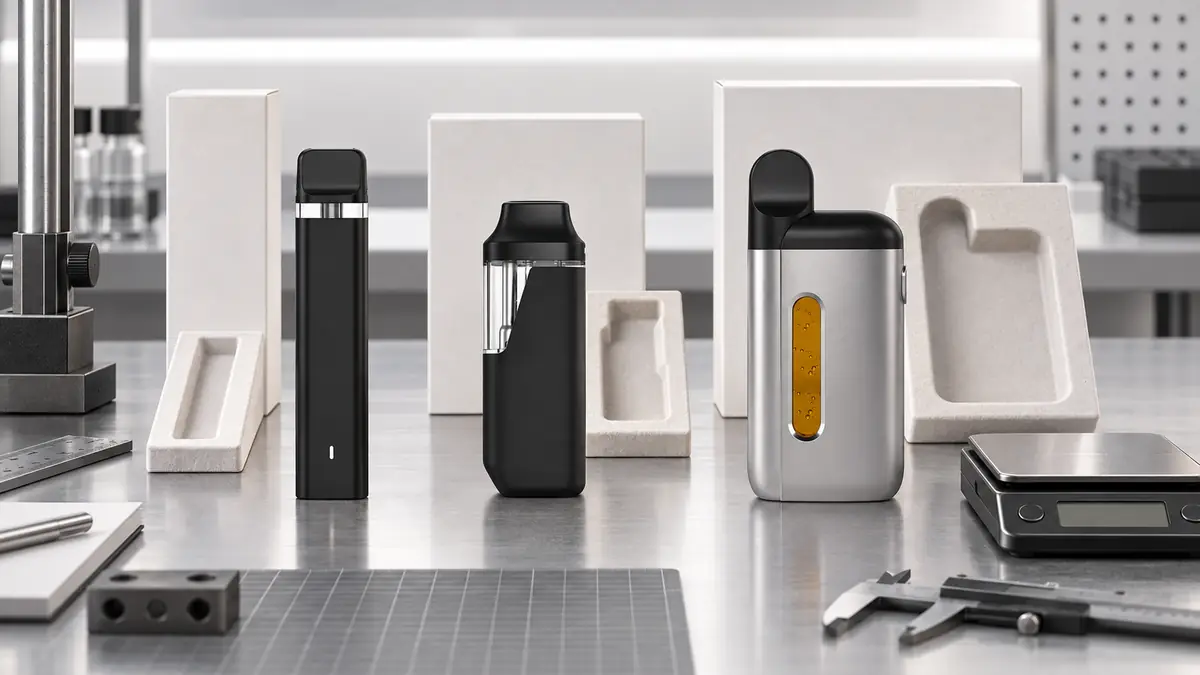
| Decision input | Candidate A: 1 mL class | Candidate B: 2 mL class | Evidence needed |
|---|---|---|---|
| Product quantity | May fit the defined target with the approved tolerance | May provide additional reservoir volume | Formulation density, target fill record, measured samples |
| Device and artwork envelope | May preserve a smaller existing carton | May require a new insert or artwork boundary | Dimensioned samples and packaging fit check |
| Filling workflow | May align with the current fixture | May require a different support or dispense sequence | Line trial and work instruction |
| Heating/power system | Must be qualified as a complete filled device | Must be qualified as a complete filled device | Model-specific data and filled-sample results |
| Commercial unit | Compare approved sellable cost and pack-out | Compare approved sellable cost and pack-out | Normalized quote and case configuration |
The table does not produce a winner by itself. It exposes which evidence is missing. If the 2 mL candidate holds the target but needs a new package and unresolved filling setup, purchasing can see that the larger label is not yet a lower-risk choice. If the 1 mL candidate cannot meet the defined quantity and tolerance, its packaging advantage does not rescue it.
Freeze the decision in one capacity-selection record
The final approval should be traceable to one hardware and process state. At minimum, record:
- supplier and exact model/revision;
- nominal reservoir capacity;
- formulation identity and applicable condition;
- target fill volume and/or mass, method, and tolerance;
- approved headspace decision where applicable;
- filling and closure equipment or fixture;
- heating, battery, activation, and charging configuration;
- device dimensions and approved artwork boundary;
- unit, inner, case, and shipping-pack configuration;
- filled-sample protocol, sample identity, results, exceptions, and approver;
- quote scope and purchasing route;
- effective date and requalification triggers.
Requalification triggers may include a reservoir, intake, heating, seal, closure, battery, firmware, material, supplier, formulation, fill-process, artwork, or packaging change. The project owner should assess the affected domains and define what must be repeated rather than assuming that the old capacity approval still applies.
Close the approval record
After the technical matrix is complete, verify that the approved model and revision are consistent across the sample, test record, quote, artwork, and purchase record. Name the decision owner and required approvers, record exceptions and the release date, and keep retained samples and supporting evidence identifiable and retrievable. The responsible team should also confirm the market, labeling, and shipping requirements applicable to the intended program. These governance checks make the preceding technical and commercial record usable without repeating it as a second checklist.
ILEVA’s current wholesale AIO disposable hardware options span multiple capacities and device architectures. Use that range to shortlist physical candidates, then qualify the exact model, formulation, fill target, process, and pack-out as one controlled configuration. Capacity is the opening input to that evaluation.